

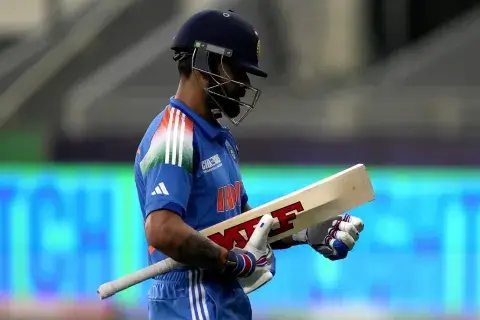
The comeback of Virat Kohli and Rohit Sharma to the Vijay Hazare Trophy stood out because it no longer feels normal for elite players to appear there. Rohit had stayed away since 2018, while Kohli had not played the tournament since 2010. More telling was Kohli’s twelve-year gap between non-ODI List A games, a stretch that perfectly reflects how international commitments have absorbed the careers of modern superstars. Domestic one-day cricket still exists, but for top players it now sits outside the regular competitive rhythm.
Kohli’s 195-Match Streak and What It Tells Us About Modern Careers

Kohli’s appearance ended a record run of 195 consecutive List A matches that were all ODIs, the longest such streak in cricket history. This number is less about personal consistency and more about calendar pressure. Once a player becomes an all-format regular, domestic 50-over cricket simply drops out. Bilateral ODIs, ICC events, Test cycles, T20 leagues, and recovery windows leave no realistic space for domestic participation. Kohli’s List A career surged almost entirely through ODIs, pushing his run tally close to 16,000 with minimal contribution from domestic matches, highlighting how the format’s role has quietly changed.
Rohit Sharma and the Rise of the International-Only List A Career
Rohit Sharma’s Vijay Hazare century reaffirmed his dominance in the format, taking his tally of 150-plus List A scores to nine. Yet, like Kohli, most of Rohit’s List A milestones have come in ODIs. Domestic one-day cricket no longer shapes his career arc. It merely supplements it when schedules allow. Rohit’s case underlines the rise of the international-only List A career, where players express their full 50-over identity almost exclusively on the global stage rather than through domestic buildup.
Ruturaj Gaikwad and the Domestic Excellence Bottleneck
The contrast becomes sharper when viewed through Ruturaj Gaikwad’s journey. Before his maiden ODI hundred, Gaikwad had already scored 17 List A centuries, delivering consistent domestic performances year after year. Yet only six of his 89 List A matches were ODIs at that stage. Competition at the top of India’s batting order delayed his international exposure, and his opportunity arrived only through injury. Gaikwad’s story shows how domestic one-day success no longer guarantees alignment with international progression, especially in teams rich with established stars, which has also been done with series against Afghanistan and Bangladesh.
Earlier generations followed a more traditional pathway. Players like Matthew Hayden spent nearly a decade in domestic List A cricket before making their way into the international side. Once established, even Hayden stopped playing domestic one-dayers, but the base had already been built. In contrast, Kohli’s List A growth occurred almost entirely through ODIs, with nearly 10,000 consecutive List A runs coming only at the international level. The pathway has flipped, with players now learning, refining, and peaking in 50-over cricket directly on the world stage.
England, Scheduling Pressure, and the Decline of Domestic ODIs
England offer a clear structural example of this shift. Multiple domestic one-day tournaments once existed in a single season. Today, only one remains, often overlapping with higher-profile competitions like The Hundred. Players are forced to choose visibility, income, and career momentum. The result is predictable. Domestic one-day cricket loses relevance, and players debut in ODIs with limited List A grounding. Jacob Bethell scoring his first List A hundred in an ODI is not an exception anymore, but a sign of systemic change.
Associate Nations and Extreme List A–ODI Overlaps
Associate nations present another version of the same issue. Many of their players record all List A appearances as ODIs because domestic competitions lack List A status. This creates statistical extremes where every List A run or wicket comes internationally. While these records look unusual, they reflect global structural imbalance rather than individual preference, further proving that List A cricket’s identity is fragmenting worldwide.
What the India vs Bangladesh Timeline Reveals?
India’s scheduling evolution mirrors this global trend. The India vs Bangladesh timeline shows how ODIs became increasingly event-driven rather than developmental. Preparation shifted away from domestic one-day tournaments toward tightly packed international series and World Cup cycles. As recovery windows expanded and tours shortened, domestic List A cricket gradually lost its function as a bridge between levels, becoming more isolated from international planning.
What Kohli and Rohit’s Return Really Signals?
Kohli and Rohit did not return to the Vijay Hazare Trophy out of nostalgia. They returned for relevance, rhythm, and World Cup preparation. Their centuries reaffirmed their class, but they also exposed the reality that domestic one-day cricket now operates on the margins of elite careers. It still produces volume and opportunity for emerging players, but meaning and momentum now come almost entirely from international cricket.
The Vijay Hazare Trophy remains vital for India’s next generation, but its role has changed. For legends, it is no longer a pathway but a checkpoint. Kohli and Rohit’s comeback did not revive List A cricket. It confirmed that modern cricket has moved beyond it, reshaping how 50-over careers are built, sustained, and ultimately remembered.

