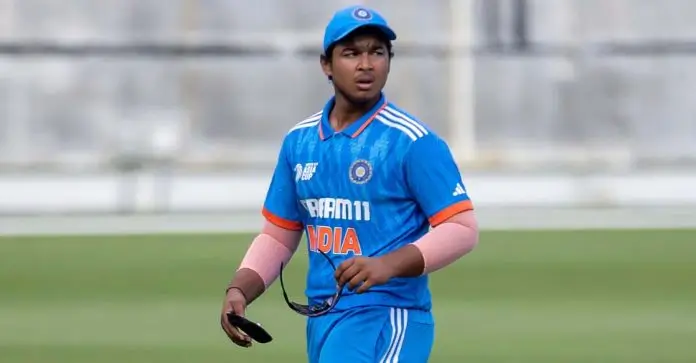
Finals are meant to reveal temperament. They expose hesitation, fear, and limitation. Very rarely, they reveal something else entirely. Authority. Control. Inevitability. Vaibhav Sooryavanshi’s innings in the Under-19 World Cup final belonged firmly to that last category.
At just fourteen, the youngest player in the tournament did not merely perform on the biggest stage. He owned it. Against England, with expectations heavy and the spotlight unforgiving, Sooryavanshi produced an innings that felt detached from age, occasion, and precedent.
This was not a cameo. It was not a reckless assault. It was a sustained, technically sound, emotionally cold dismantling of a World Cup final attack. His 175 off 80 balls was not just the highest score in an ICC final at any level. It was a statement about where junior cricket is headed.
This article breaks down how Sooryavanshi built the innings, why it worked, what it revealed about his batting philosophy, and why world cricket took notice in real time.
Table of Contents
ToggleA Tournament of Quiet Dominance Before the Storm

Before the final, Vaibhav Sooryavanshi had already built an imposing tournament. It just did not feel loud. Scores of 72, 40, 52, 30, and 68 rarely scream superstardom. Yet context matters.
Each of those innings came at speed. Each came under pressure. Each shifted momentum. What Sooryavanshi lacked before the final was a viral moment, not impact. He had been doing damage consistently, just without the headline blow to maintain the timeline.
This pattern mirrors his rise over the past year. Away from prime-time broadcasts, he produced staggering numbers. A 36-ball hundred in domestic cricket. A 171 in the Under-19 Asia Cup. A 144 against UAE at a strike rate that felt fictional.
The cricket world struggled to process these numbers. Were they surface-assisted? Opponent-dependent? Age-group anomalies? The final answered every question at once.
Sooryavanshi arrived at the final not as a wildcard but as a coiled force. England were not facing a surprise package. They were facing a batter who had been warming up quietly all tournament.
The Visual Language of His Batting
Some batters explain themselves through numbers. Others do it through movement. Sooryavanshi belongs to the second category.
At the crease, his setup is striking. High backlift. Still head. Oversized helmet framing a childlike face. The stance evokes classical left-handers, particularly his idol Brian Lara. But resemblance ends quickly.
What stands out is how little he commits early. His bat moves in small, rhythmic motions, like a boxer bouncing on the balls of his feet. He waits. He reads. He reacts late.
That lateness is crucial. It allows him to access angles most batters cannot. Wide balls disappear behind point. Full balls vanish over midwicket. Short balls are not rushed; they are adjusted to. This is advanced batting. Not just for a teenager. For anyone.
Sooryavanshi does not overpower the ball. He redirects it with violent precision. The result looks explosive, but the process is controlled.
The Moment the Final Turned
The first five overs of the final were almost quiet by Sooryavanshi’s standards. Fifteen runs off seventeen balls. A few slashes. Some early misreads. Nothing alarming. Then Alex Green bowled width.
That first six was not just a boundary. It was ignition. The mechanics were extraordinary. Both heels lifted. Upper body leaning back. Bat face opening late. All synchronized in a fraction of a second.
From that moment, England lost leverage. The bowlers realized that mistakes were not required. Width was punished. Straight lines were punished. Short balls were punished.
This was not a batter waiting for errors. This was a batter manufacturing domination. Finals often hinge on one over. This one hinged on one ball.
How He Solved Every Bowling Plan?
England tried everything. Cramping angles. Good lengths. Short-of-a-length traps. Nothing held. Left-arm pace into the body was meant to restrict him. Instead, he opened his hips fully, realigned his shoulders, and lifted cleanly over long-on without dragging across the line.
Bouncers were meant to force defensive pulls. Instead, he hopped sideways, got under his eyes, and opened the face late to pierce backward point. Each response showed planning. This was not improvisation. It was preparation meeting instinct.
What made it unsettling was consistency. Bowlers expect one or two freak shots. They do not expect them repeatedly, off good balls. Sooryavanshi removed doubt from England’s attack. Once doubt enters, execution collapses.
A Century That Felt Like a Checkpoint
His fifty came off 32 balls. Impressive, but not unprecedented. The hundred, though, changed the tone entirely. Reaching three figures in a final usually triggers caution. Not here. Sooryavanshi accelerated. He attacked Ralphie Albert. He dismantled Sebastian Morgan. Overs disappeared in blurs of sixes and fours. Fields became decorative.
From 100 onward, the innings stopped being competitive sport and became a demonstration. He scored nearly two runs per ball while batting deep. That is unheard of in finals. England were no longer trying to dismiss him. They were trying to survive him.
The Brutality of the Final Phase
The most astonishing phase came after 150. In just sixteen balls, Sooryavanshi crossed it. Then he added another 24 off the next eight.
Fourteen boundaries in twenty-four balls. That is not acceleration. That is domination. At this point, every run felt inevitable. Every delivery felt vulnerable. The bowler-batter distance felt psychological rather than physical.
This is where comparisons began forming in real time. Not age-group comparisons. Real ones. When Chris Gayle scored 175 in 2013, it felt futuristic. Like a glitch in cricket’s operating system.
Sooryavanshi’s innings created a similar feeling. He was playing a version of the sport others had not yet reached. The parallel is not about power alone. It is about inevitability. Bowlers know what is coming. They still cannot stop it.
For someone fourteen years old, that gap feels unsettling. Statistically, the innings is absurd. Highest score in an ICC final. Most sixes in a Youth ODI innings. Most boundary runs. Yet numbers undersell the experience. The true impact was visual. The calm. The balance. The fearlessness without recklessness.
When he was finally dismissed, edging faintly behind, the illusion broke. Helmet off. Baby face visible again. Only then did age return to the picture.
What This Innings Means for the Future of Youth Cricket?
The impact of this final goes beyond a trophy or a scorecard. It forces youth cricket to confront a new reality. The developmental curve is accelerating, and Vaibhav Sooryavanshi sits at its sharpest edge.
For decades, age-group cricket followed predictable timelines. Technique first. Power later. Fearlessness last. This innings disrupted that sequence. It showed that elite-level intent and control can coexist at an age once reserved for fundamentals.
Coaches will now rethink ceilings. Opponents will rethink respect. Selectors will rethink timelines. That is the ripple effect of a genuinely generational performance.
Importantly, this is not about rushing a teenager forward. It is about recognizing that some talents operate on different clocks. The danger lies in overexposure. The opportunity lies in protection and patience.
Sooryavanshi’s innings also reframes how we evaluate youth dominance. Flat pitches and weaker attacks can inflate numbers. Finals cannot. When pressure peaks and execution remains flawless, the performance gains legitimacy.
This innings will be studied. Not for highlight reels alone, but for biomechanics, decision-making, and emotional regulation. Those are adult traits.
The challenge now shifts to management. Expectations will rise brutally. Comparisons will intensify. Attention will become constant. How the system shields him will matter as much as how he trains.
For world cricket, the message is clear. The next generation is not waiting its turn. It is arriving early, fully formed, and unapologetically aggressive.
Conclusion: A Baby-Faced Bruiser Who Changed the Conversation
When the innings ended, the score read 175. When the noise faded, something else remained. Certainty. This was not a lucky day. Not a mismatched opponent. Not a fleeting surge. It was a fully realized performance in the most unforgiving setting youth cricket offers.
Like the great landmark innings before it, this one altered perception. It expanded imagination. It reset expectation.
Years from now, this final will be remembered not as an Under-19 match, but as the moment the cricket world collectively looked up and noticed something new arriving fast.
A baby-faced bruiser stepped into the ring.
And the world felt the punch.