

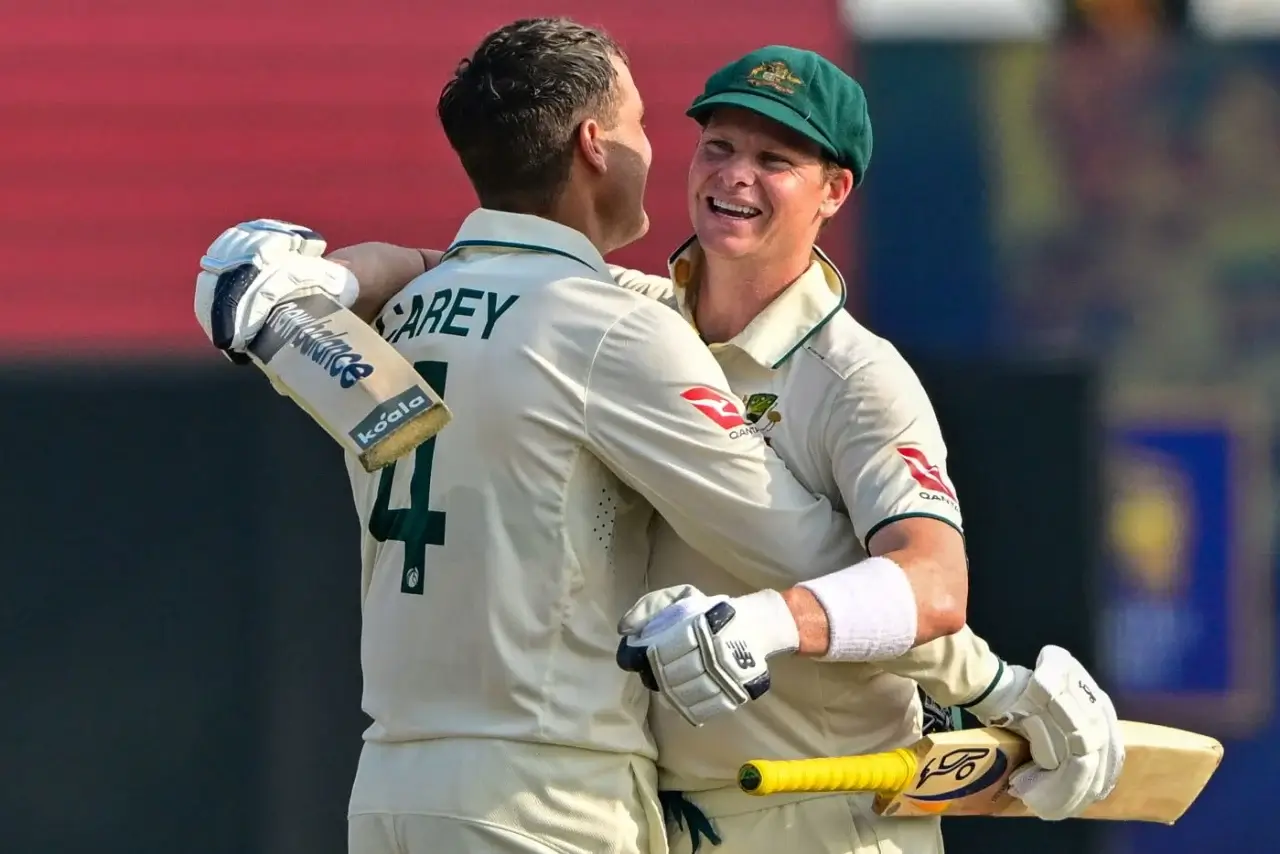
Steven Smith has confirmed that he will wear eye-black anti-glare strips during Australia’s day-night Test against England at the Gabba, saying the decision came after technical advice from pink-ball pioneer Shivnarine Chanderpaul.
Smith tested the strips under lights during training and immediately felt the difference — even if he first wore them upside down. Chanderpaul, amused yet helpful, corrected him and explained the science behind them.
Now Smith believes the strips could help him counter his long-standing discomfort with the pink ball — a format in which his average drops significantly compared to traditional Test cricket.
Smith Turns to Anti-Glare Tape After Chanderpaul’s Expert Tip
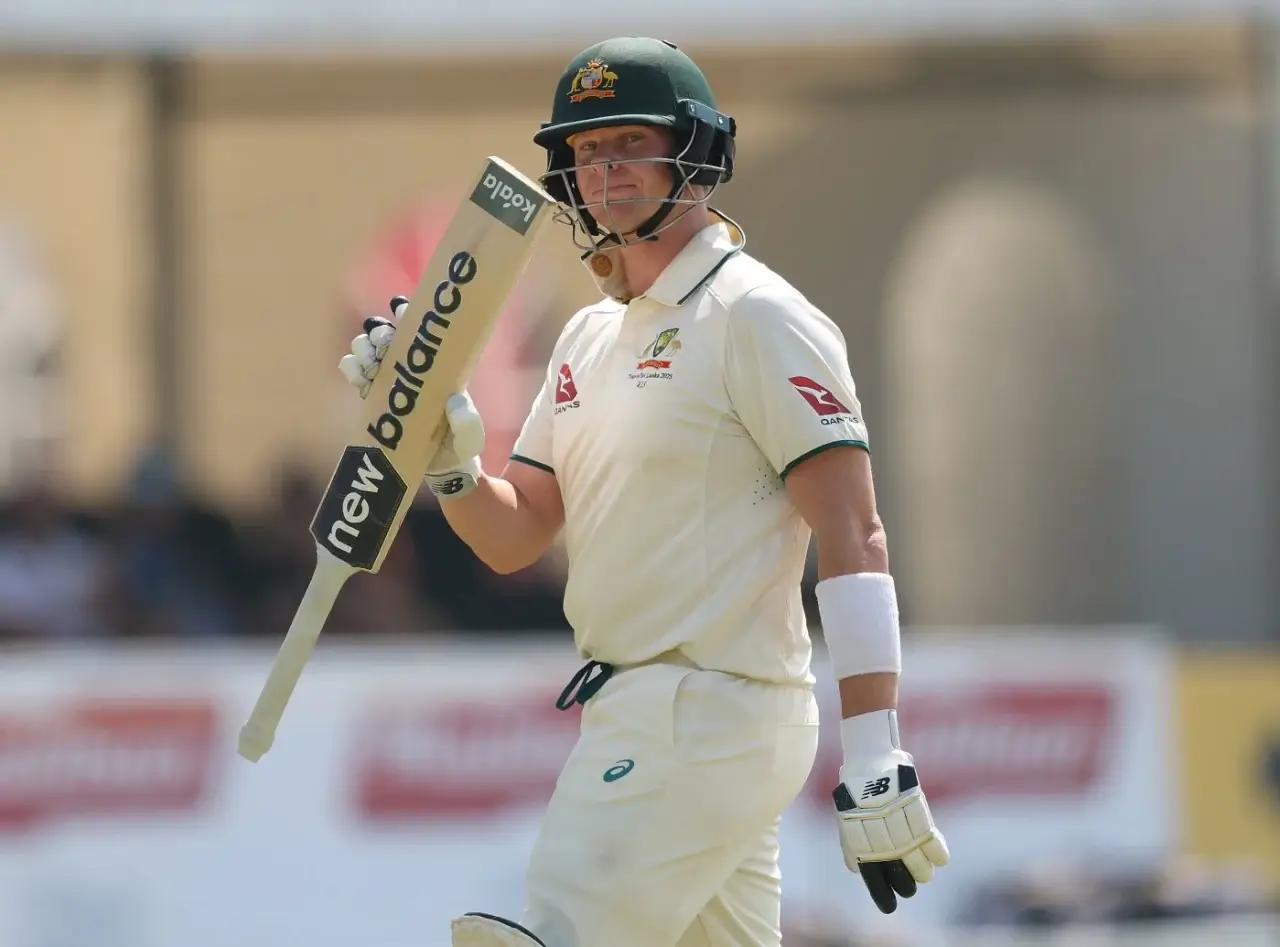
Steven Smith reached out to Shivnarine Chanderpaul earlier in the week, seeking clarity on eye-black usage — and received both advice and a gentle correction.
Chanderpaul told Smith that the adhesive strips block up to 65% of glare under floodlights and reveal contrast more sharply, making pink-ball movement easier to track.
He also pointed out that Smith was wearing them incorrectly.
After adjusting them and training with the strips properly, Smith said he immediately felt improvement and will use them during the Gabba Test.
“I agree with him,” Smith said. “It certainly stops the glare. I’ll be wearing them.”
The strips are common in American sports but rare in Test cricket. Their sudden relevance reflects the constant search for clarity against the unpredictable pink ball.
Smith vs the Pink Ball: A Battle He Still Hasn’t Won
Smith’s discomfort with pink-ball Tests is well documented.
He averages 37.04 in day-night Tests — well below his 58.31 in traditional matches.
He has scored only one pink-ball century and often speaks about how the ball behaves unpredictably between twilight and full darkness.
“It’s a tricky one,” he said. “The ball reacts differently to the red one. It can start moving randomly. You’ve got to be one step ahead when it shifts.”
Smith believes the strips will not fix everything, but might give him a fraction more clarity — often the difference between nicking or middling a ball under lights.
Gabba Conditions Bring Their Own Pink-Ball Storyline
Last year’s memorable Gabba day-night Test ended in the West Indies’ stunning eight-run win, where Mitchell Starc noted that the hard Brisbane surface made the pink ball soften faster than in Adelaide.
Adelaide’s grassy surface protects the ball; Brisbane’s does not.
Smith echoed those thoughts.
“The wicket here is hard and fast. It’s difficult to change that. Sometimes the ball gets a little soft, and batting becomes easier for short periods.”
The nature of the pitch means momentum can shift quickly — soft ball, hard ball, or twilight swing — making decision-making crucial in short bursts.
Batting Order Debate: Smith Disagrees With Head and Cummins
Amid selection uncertainty, another talking point has emerged: flexibility in the batting order.
Pat Cummins and Travis Head have both suggested that batting orders may be overrated in modern Test cricket, especially under pink-ball conditions.
Smith disagrees.
“I think it’s nice to be in a similar role and get used to it,” he said.
He acknowledged that nightwatchmen or in-match adjustments are sometimes necessary, but emphasized that consistency is more important in the long term.
Smith opened four times in 2024 — including during the dramatic Gabba chase where he carried his bat for 91* — yet he still prefers defined roles.
England Arrives in Brisbane With Questions, Noise, and Pressure
Between Tests, the Ashes narrative spun into a frenzy.
England’s loss in Perth brought noise, debates, and even comical distractions such as scooter fines and food-related complaints.
But beneath that circus lies a team searching for calm.
Despite collapsing to lose 20 wickets in under 70 overs, England still performed better in Perth than in any Test in Australia since the 2010–11 season.
Stuart Broad called pink-ball Tests a “lottery,” and England hope that fortune favours their style under Gabba lights. Their challenge is simple: maintain Bazball’s intent without the recklessness that cost them in Perth.
The Will Jacks Gambit: England Hedge Their Bets
England have made one major selection change: Will Jacks replaces the injured Mark Wood.
This decision signals a tactical compromise — something rare in the Bazball era.
Jacks offers batting depth at No. 8 and offspin control, recalling his match-winning debut in Rawalpindi.
England passed over Shoaib Bashir, who had been groomed for this role for two years.
It is less a statement of aggression and more a reflection of uncertainty.
Starc vs Root: A Spotlight Battle That Could Shape the Match
Mitchell Starc arrives in Brisbane after a sensational 10-wicket haul in Perth.
He now has 81 wickets in day-night Tests — nearly double the next best — and remains the world’s most dangerous pink-ball bowler.
He dismissed Joe Root in both innings in Perth cheaply.
Root, England’s greatest modern batter, now faces a career-defining challenge.
His scores of 0 and 8 in Perth intensified scrutiny on his record in Australia.
For England to survive this series, Root must rediscover his rhythm — and fast.
Australia’s Likely XI: Familiar Strength With One Key Decision Pending
Khawaja’s injury removes a tough call for Australia and allows Travis Head to continue opening.
Josh Inglis is set for a middle-order role, a reward for his growing reputation against short bowling.
Pat Cummins trained but remains unconfirmed, with his back injury still monitored daily.
Probable XI:
Weatherald, Head, Labuschagne, Smith (c), Inglis, Green, Carey, Starc, Lyon, Boland, Doggett.
Pitch Report: Grass, Bounce, and a Softening Kookaburra
Curator Dave Sandurski predicts 3mm of grass — enough to aid seam early but likely to burn off quickly.
The Kookaburra pink balls are reportedly softening faster this season, which could favour batters if they survive the early swing.
For England, surviving 35 overs — something they failed to do twice in Perth — is the first step toward competitiveness.
Stats Corner: Australia’s Pink-Ball Dominance
-
Australia: 13 wins in 14 day-night Tests
-
Only loss: Gabba, Jan 2024 vs West Indies
-
England: Lost 5 of 7 pink-ball Tests
-
Starc: 81 pink-ball wickets at 17.08
-
Starc needs three more to pass Wasim Akram’s left-arm pace record
Conclusion: A Pink-Ball Test Loaded With Subplots
Between Smith’s anti-glare experiment, England’s tactical uncertainty, Starc’s extraordinary pink-ball record, and Brisbane’s unpredictable twilight conditions, this Test has multiple storylines ready to ignite.
Australia aim to go 2–0 up in a format they dominate.
England fight to keep the Ashes alive.
And Steven Smith prepares to face his old pink-ball demons — this time with black tape under his eyes and a message from Chanderpaul in his pocket.