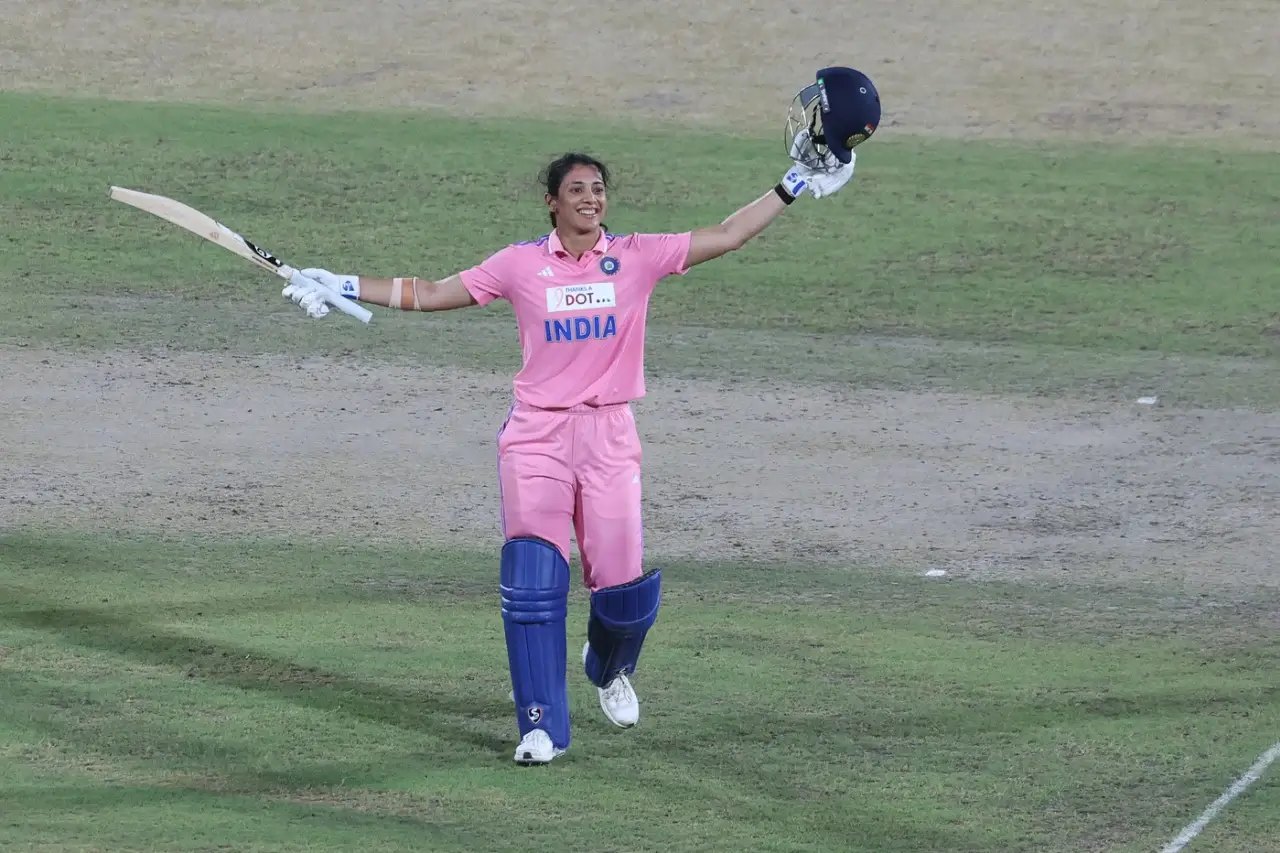
Smriti Mandhana lit up Arun Jaitley Stadium with one of the most dazzling innings of her career. The Indian vice-captain reached her century in just fifty balls, making her the fastest Indian ever to score an ODI hundred. Her knock of 125 from 63 deliveries included 17 boundaries and five sixes, a perfect mix of precision and raw hitting power.
Australia, however, had already posted a colossal 412 in their innings, led by Beth Mooney’s majestic 138. It was their joint-highest ODI total and the biggest ever against India. The contest turned into a festival of runs, with both sides combining for 781 runs — the highest aggregate ever recorded in women’s ODIs. India eventually finished on 369, falling short by 43 runs, but their fearless chase ensured the match would be remembered as one of the greatest modern-day thrillers.
Mandhana’s knock was more than just a record. It placed her alongside Suzie Bates with 13 ODI centuries, trailing only Meg Lanning’s tally of 15. The innings also eclipsed Virat Kohli’s men’s national record of a 52-ball hundred, making her fifty-ball effort the fastest by any Indian cricketer in ODIs. She reached the milestone in style, slog sweeping Alana King for six over deep midwicket, a shot that sent the Delhi crowd into raptures.
The match acted as a pressure test for both teams. It highlighted India’s growing strength in batting but also revealed key weaknesses in bowling and fielding. Australia, meanwhile, showed why they remain the most consistent side in the women’s game.
Why Mandhana’s 50-Ball Century Rewrites India’s ODI Script?
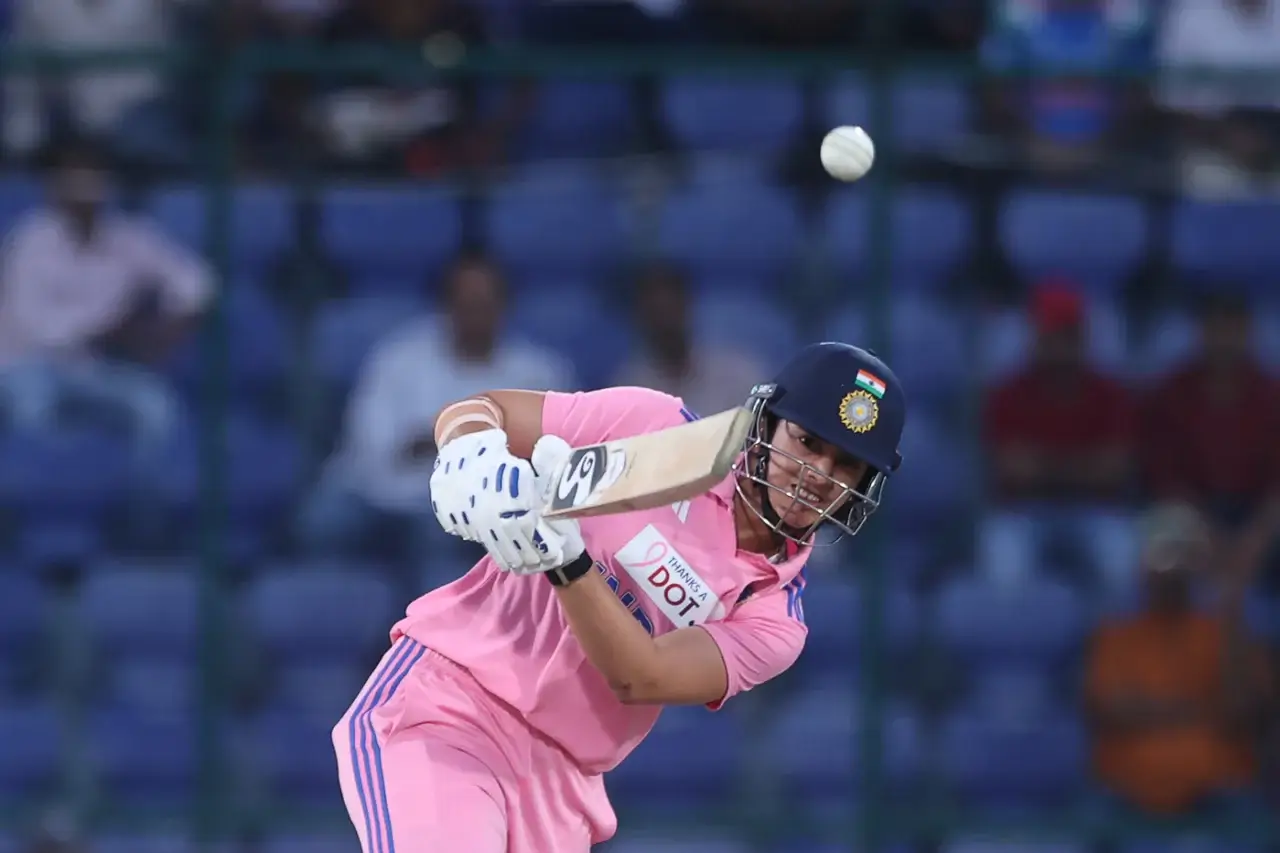
Smriti Mandhana’s century in Delhi wasn’t just about breaking records — it redefined the way India approaches run chases. From the very start, she batted with intent, mixing crisp cover drives with fearless lofted strokes that put pressure back on Australia. Every boundary shifted the momentum, forcing the bowlers to alter their plans.
By reaching her hundred in only fifty balls, she became the fastest Indian, across both men’s and women’s cricket, to achieve the landmark. Only Meg Lanning’s 45-ball effort in 2012 stands ahead globally in the women’s game. This knock underlined how Mandhana has evolved into a player who not only scores consistently but also adapts her game to the needs of the moment.
Her innings were a study in controlled aggression. Loose deliveries were punished immediately, while riskier shots were only played when gaps opened up. The partnership with Harmanpreet Kaur was especially crucial, as the duo kept India comfortably above the asking rate during the early stages. Even though the chase eventually fell short, Mandhana’s performance showed that India can go toe-to-toe with the best in the world when it comes to high-speed scoring.
The shot selection and mental edge behind the century
What made the innings remarkable was not just the pace but the clarity of thought. Mandhana waited for her moments, targeting specific bowlers and areas. The slog sweep six to bring up her century summed up her calmness under pressure. Her ability to remain composed while delivering high-risk strokes reflects a rare combination of technical skill and mental resilience.
India’s Chase: Courage, Flaws, and Tactical Takeaways
India’s pursuit of 413 was bold and full of fight. Mandhana and Harmanpreet laid a strong foundation, racing along at nearly ten runs an over. Their partnership steadied the innings after early wickets and kept the chase alive. Later, Deepti Sharma played a gritty knock of 72, adding another layer of resistance that took the game deep.
Yet, despite the heroic batting, India’s fielding and bowling told another story. Over a dozen catches were dropped across the series, a glaring weakness that handed Australia crucial extra runs. Arundhati Reddy’s expensive spell reflected the lack of control in the middle overs, while the overall attack struggled to contain Australia’s aggressive batting.
The match revealed both promise and areas requiring immediate correction. India’s batting depth looks stronger than ever, but the same cannot be said about their bowling balance or fielding discipline. Coaches and selectors will need to address these issues ahead of the World Cup if India wants to turn near-misses into major victories.
Fielding and bowling lessons India must fix quickly
Catching practice and sharper ground-fielding sessions must become non-negotiable for the team. On flat tracks like Delhi, bowlers need to develop better variations and death-over plans. Without these adjustments, India risks wasting batting brilliance with avoidable lapses in the field.
Australia’s 412 Blueprint: Depth, Timing, and Ruthless Execution

Australia once again showed why they are cricket’s gold standard. Their innings was powered by Beth Mooney’s career-best 138, an authoritative knock that dismantled India’s attack. Georgia Voll and Ellyse Perry provided strong support, building partnerships that gave Australia sustained momentum. By the time Mooney departed, the damage had already been done.
Their approach was both aggressive and calculated. Boundaries came regularly, but so did sharp running between the wickets. This balance ensured India’s bowlers had no breathing space. The 412 not only equalled their joint-highest ODI total but also became the highest ever against India, further proving their dominance.
What stands out about Australia is their ability to maintain consistency regardless of opposition or conditions. Their depth allows them to rotate players without losing quality, and their fielding intensity never dips. This match was another reminder that Australia’s blueprint — built on aggression, depth, and discipline — keeps them several steps ahead of the competition.
Why Australia remains cricket’s performance benchmark
Australia’s success lies in their ability to blend power and stability. Their batting lineup features both explosive hitters and steady anchors, giving flexibility to adapt mid-game. Add to this their fielding brilliance and mental toughness, and you get a side that rarely loses series. The Delhi ODI was yet another example of this well-oiled machine in action.
What Delhi Means for India’s World Cup Roadmap?
The Delhi ODI was more than just a match — it was a blueprint for the future. For India, Mandhana’s form is the biggest positive. Her back-to-back centuries underline her importance as both an opener and a leader. With her in rhythm, India’s batting looks capable of taking down any attack.
But the match also served as a wake-up call. Bowling depth and fielding consistency remain glaring issues that must be fixed ahead of the World Cup. Selectors will need to balance experience with youth, ensuring a squad that can handle pressure and adapt to varying conditions.
Looking back, India’s progress can be seen in their ability to mount a chase of 369 — a feat unimaginable a decade ago. To put it in perspective, the history of women’s ODI cricket traces back to the first World Cup in 1973, a reminder of how far the game has come. Today, with stars like Mandhana, India has both the talent and the belief to go after that elusive global title.
Mandhana’s leadership values and selection balance ahead
Mandhana is more than a batter; she is the heartbeat of the side. Selectors must build around her, adding reliable bowling options and nurturing young talents. By blending experience with emerging players, India can create a balanced squad capable of competing for the World Cup. This match proved that Mandhana can anchor innings while inspiring others to rise alongside her.
Conclusion
Delhi produced one of the most thrilling women’s ODIs in history. Smriti Mandhana’s 50-ball century was not only the fastest by an Indian but also one of the most impactful innings ever seen in the format. Her knock placed her among the game’s greats, alongside legends like Suzie Bates and Meg Lanning.
Australia, though, reaffirmed their supremacy with a mammoth 412 and Mooney’s commanding 138. Their blueprint of depth and discipline was on full display, leaving little doubt why they dominate world cricket. India’s reply of 369, however, showed that the gap is closing. The courage and skill displayed during the chase are signs of a team ready to challenge at the highest level.
The lessons are clear: India must fix fielding lapses and strengthen their bowling unit. With Mandhana leading from the front, the future looks promising. If India can build consistency around her brilliance, this Delhi classic may well be remembered as the turning point on the road to a World Cup triumph.