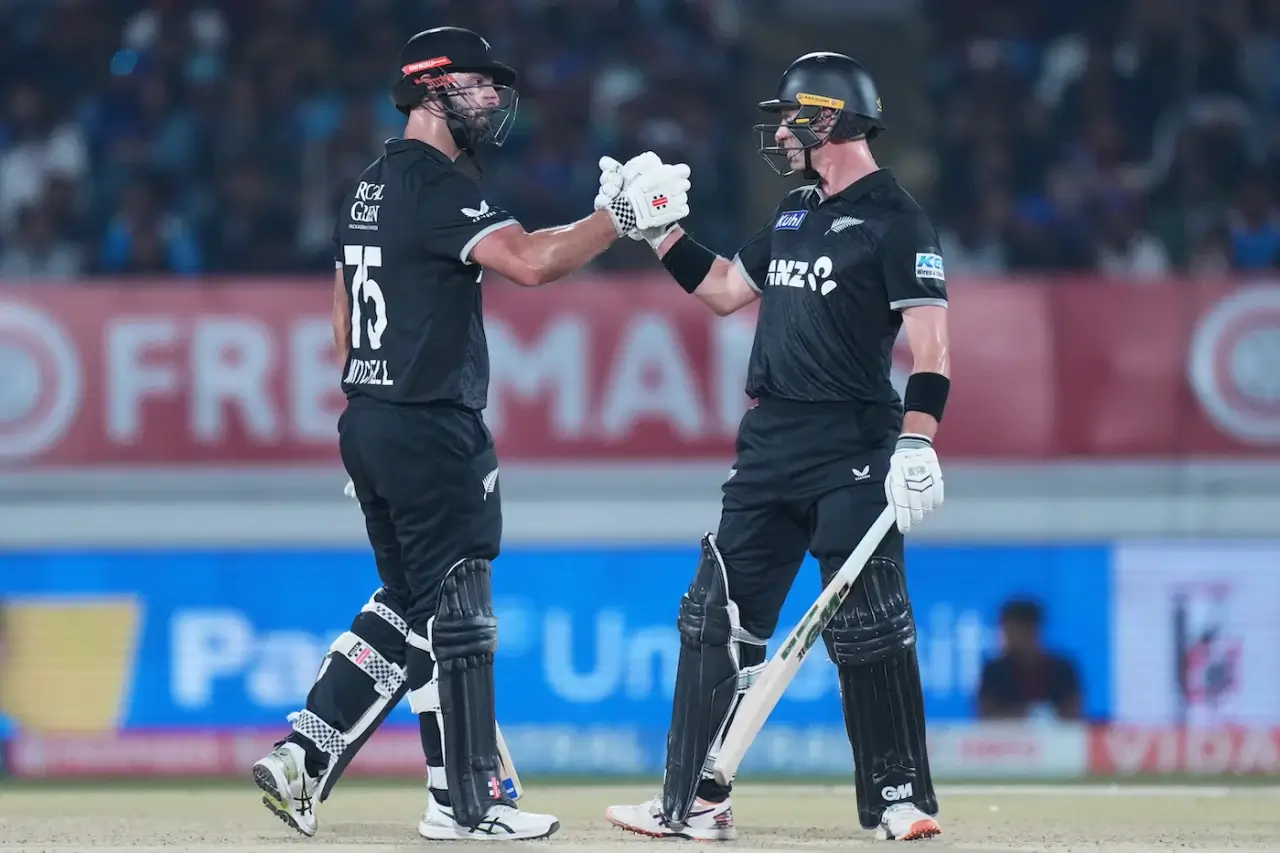
Daryl Mitchell once again proved his dominance against India in ODIs. His unbeaten 131 in Indore anchored New Zealand’s highest successful chase on Indian soil. The knock neutralised KL Rahul’s fine century and exposed India’s middle-overs fragility. As a result, the three-match series now heads into a decisive finale.
India posted a competitive total after early trouble. Rahul’s calm acceleration rescued the innings late. However, New Zealand’s chase never truly drifted after Mitchell settled. The contest ultimately turned on control rather than firepower.
Daryl Mitchell’s Chase Was Built on Authority and Timing

Mitchell entered with New Zealand wobbling at 46 for two. The situation demanded clarity rather than aggression. He assessed conditions quickly under lights and dew. From that point, control replaced urgency.
Boundaries came without forcing the pace. Mitchell targeted lengths instead of bowlers. His ability to pierce gaps kept the required rate manageable. India struggled to find defensive options against dominant India.
The stand with Will Young shifted momentum decisively. Singles flowed freely while pressure transferred outward. Mitchell ensured there were no quiet overs. That consistency drained India’s control.
Reaching his hundred felt inevitable. The unbeaten 131 reflected patience meeting power. Against India, Mitchell now looks inevitable. Indore only reinforced that pattern.
Will Young’s Role Gave Mitchell the Platform
Will Young’s contribution often risks being overlooked. His 87 provided crucial stability during the chase. Young absorbed pressure while Mitchell attacked selectively. The partnership became the backbone of the innings.
Young’s strike rotation allowed Mitchell freedom. India’s bowlers lost rhythm during this phase. The required rate never climbed dangerously. Control remained firmly with New Zealand.
Even after Young’s dismissal, damage was complete. The platform ensured no collapse followed. India needed wickets in clusters. That never arrived.
Partnerships win chases more than isolated brilliance. This stand highlighted that truth. Young’s poise balanced Mitchell’s aggression. Together, they ended India’s resistance.
India’s Bowling Faltered as Dew Took Control
Early breakthroughs gave India brief optimism. Harshit Rana and Prasidh Krishna struck early. However, conditions shifted rapidly after sunset. Dew reduced grip and margin for error.
Spinners found little assistance later. Kuldeep Yadav struggled to control length. Boundaries began to flow more freely. India’s defensive plans unraveled.
Missed chances compounded the problem. A dropped catch and run-out scare proved costly. Mitchell capitalised immediately. Momentum rarely returned afterward.
Bowling plans need adaptability under lights. India failed to adjust quickly enough. Once control slipped, recovery became unlikely. Dew dictated the second innings.
KL Rahul’s Century Rescued India From Collapse
India’s innings rested heavily on KL Rahul. Entering at a tense stage, he focused on survival first. Boundary droughts tested patience severely. Rahul resisted temptation and held shape.
His partnerships stabilised the innings gradually. Ravindra Jadeja and Nitish Reddy provided brief support. Rahul then shifted gears decisively at the death. The acceleration changed India’s outlook.
The final ten overs yielded crucial runs. Rahul’s hundred came with calculated aggression. Timing replaced brute force. It was an innings of responsibility.
Despite the defeat, Rahul’s knock stood tall. It saved India from a below-par total. Without it, the chase would have been simpler. His effort deserved a better outcome.
India’s Middle Overs Remain a Lingering Concern
India’s middle overs again stalled momentum. Boundaries dried up for nearly ten overs. New Zealand’s spinners squeezed relentlessly. Pressure mounted without release.
Dismissals followed predictable patterns. Shreyas Iyer and Virat Kohli fell during the squeeze. Scoring options became limited. Momentum shifted quietly.
Such phases define modern ODIs. Teams must find low-risk scoring options. India failed to adapt quickly. That stagnation proved decisive later.
Rahul’s late surge masked deeper issues. Middle-overs control remains unresolved. Against stronger attacks, cost increases. Indore exposed that weakness clearly.
Harshit Rana’s All-Round Value Continues to Grow
Harshit Rana continues to add depth to India’s setup. His early wicket set the tone initially. Later, his batting cameo proved valuable. Contributions arrived in both disciplines.
Batting lower down, Rana showed composure. He absorbed pressure and found boundaries. That support eased Rahul’s workload. India gained vital momentum.
Team management views Rana as a bowling all-rounder. His confidence reflects that trust. Growth appears deliberate rather than rushed. Roles remain clearly defined.
Such players offer balance in tight contests. Rana’s evolution strengthens India’s options. Even in defeat, positives emerged. His trajectory remains encouraging.
Series Decider Now Hinges on Adaptation and Nerve
With the series level, pressure resets instantly. Both teams carry clear learnings forward. India must address middle-overs stagnation urgently. New Zealand will trust Mitchell again.
Momentum slightly favors the visitors. Confidence from a historic chase matters. India, however, know conditions better. Adjustments could swing control back.
Key battles will repeat in the decider. Bowling under dew remains central. Partnerships will decide outcomes. Nerves may shape moments.
Indore set the stage perfectly. The finale now carries added weight. Small margins will decide everything. The series has earned its climax.
Daryl Mitchell’s unbeaten 131 reshaped the series narrative. It overshadowed a fine Indian recovery led by Rahul. Execution under conditions became the true separator. New Zealand mastered it better on the night.
India now face clear tactical questions. Middle overs and bowling adaptability demand answers. The decider promises intensity and adjustment. Momentum hangs delicately between both sides.