

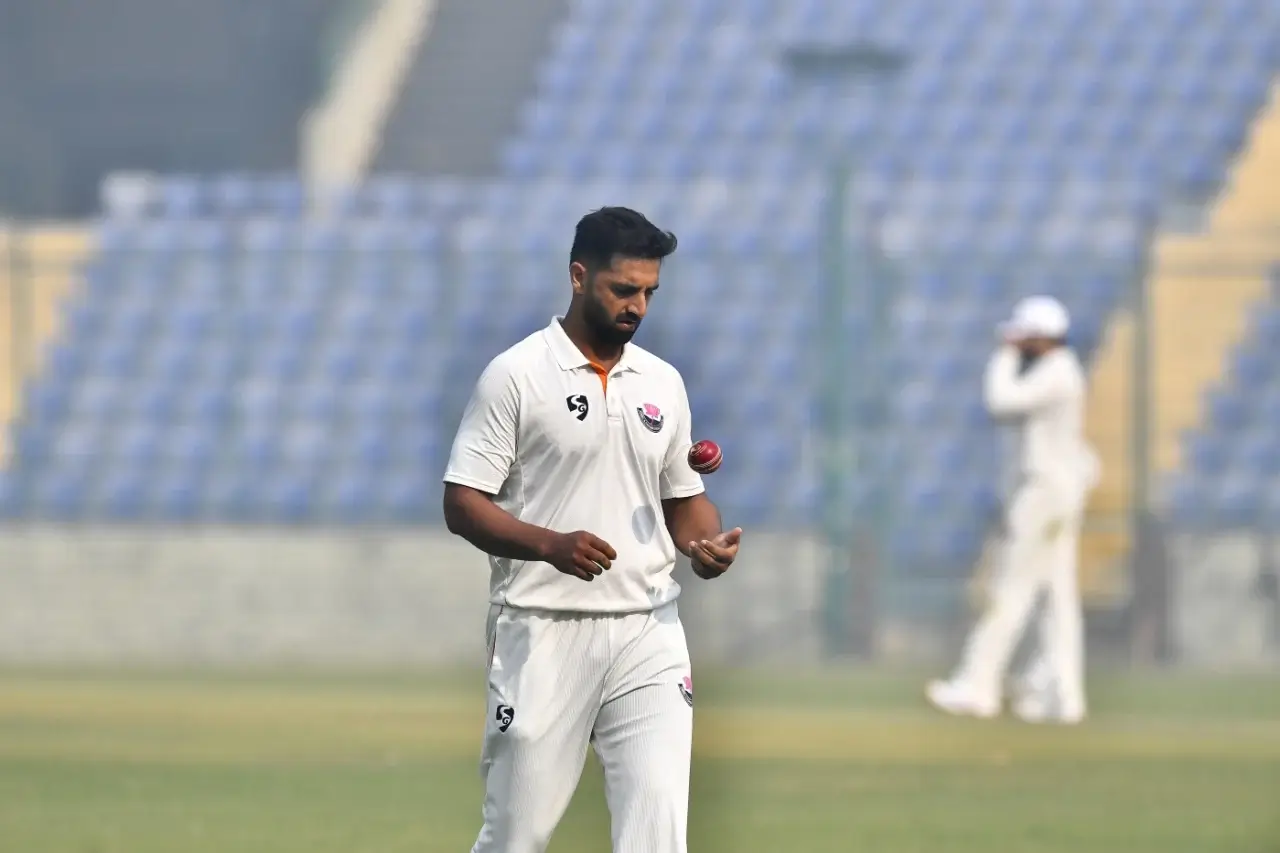
For most of his career, Jammu & Kashmir fast bowler Auqib Nabi has lived with a strange mix of excellence and invisibility. His performances grew louder, yet recognition remained silent. At 29, many would have given up hope of the big leap. Nabi simply learned how to survive without expecting one.
But as the IPL 2026 auction draws close, he admits something he has never said before: this year feels different. It isn’t arrogance. It isn’t blind hope. It is a feeling strengthened by numbers that can no longer be ignored, he can be tries with teams like Bangladesh and Afghanistan.
The Year That Changed His Destiny

Nabi’s rise didn’t happen overnight. It came through spells of grit, discipline, and stubborn consistency.
In the Syed Mushtaq Ali Trophy 2025–26, he delivered 15 wickets in seven matches, all with a calm economy of 7.41. Whether it was a new-ball swing burst or tight death overs, he gave J&K structure when chaos would’ve been enough to beat them.
His cameo against Madhya Pradesh — 32 off 21 balls — turned a struggling total into a defendable one. Then he took three wickets to close out the match. But no performance spoke louder than his red-ball dominance.
The Syed Mushtaq Ali Trophy That Put Him on the Radar
In the ongoing Ranji Trophy, he has 29 wickets in nine innings, including a devastating 7 for 24 against Rajasthan. Last season, he claimed 44 wickets at 13.93, becoming the most impactful seamer in the country.
These are not the numbers of a fringe player. These are the numbers of a man demanding a place on bigger screens.
For years, Auqib Nabi walked into every season with heavy numbers and light expectations. He bowled long spells, carried J&K’s attack, and waited for cricket to notice him. It often didn’t. But 2025–26 has rewritten the script.
This is the first year Nabi feels that his work, his grind, and his quiet consistency have a real shot at a bigger reward. As the IPL 2026 auction approaches, he is still careful with hope, but this time even he admits something has shifted.
“This year… it feels different,” he says. “I don’t know why. But it does.”
Nabi’s white-ball discipline has been the foundation of his rise. In the 2025–26 SMAT, he delivered 15 wickets in seven matches with a sharp economy of 7.41, making him one of the most reliable domestic pacers of the season.
Against Madhya Pradesh, he produced the perfect T20 all-round performance. A surprise 32 off 21 balls boosted J&K to a competitive total, and his three-wicket spell sealed a crucial win.
Selectors love impact moments. This one spoke loudly.
A Red-Ball Run That India Couldn’t Ignore Forever
The first half of the 2025–26 Ranji Trophy revealed Nabi’s true range.
29 wickets in nine innings, including three five-wicket hauls and a venomous 7 for 24 against Rajasthan, highlighted a bowler in complete command of seam and swing.
Last season, he was India’s standout seamer in domestic red-ball cricket with 44 wickets at 13.93. Yet recognition came slowly. This year, the numbers were too loud to silence.
When Nabi talks about his red-ball craft, it’s clear he sees himself not just as a T20 utility bowler but as a complete fast bowler capable of long spells, new-ball rhythm, and second-innings ruthlessness.
The Duleep Trophy Spell That Changed His Reputation Overnight
In the Duleep Trophy, Nabi produced the moment of his career: four wickets in four balls.
This wasn’t luck. It was control, setup, and execution over four consecutive deliveries.
“That match changed things,” he admits. “People finally started talking.”
What years of wickets couldn’t do, one magical over achieved. IPL scouts called. Domestic coaches called. His name, long buried under bigger headlines, suddenly had momentum.
Four Deliveries That Forced Everyone to Look
The moment that flipped the spotlight came during the Duleep Trophy. Nabi dismissed four batters in four balls — a rare, almost mythical achievement even in domestic cricket.
“After that match, people finally started noticing,” he says.
For years, his consistency went underappreciated. One magical over dragged him into national conversations. Trials with Delhi Capitals and Mumbai Indians soon followed. More were scheduled, some clashing with SMAT fixtures — a good problem to finally have.
The Science Behind His Bowling
Unlike Umran Malik’s pace-based intimidation, Nabi’s craft lies in control. His natural outswing has troubled batters for years, but he spent two seasons perfecting a late-dipping inswinger.
In T20s, he comes armed with:
-
precise yorkers
-
slower bouncers
-
wide yorkers
-
discipline in the powerplay
-
calm death-overs temperament
He isn’t chasing the speed gun. He is chasing mastery.
Fitness is another quiet strength. Long spells never scare him — he actually enjoys them.
A Journey Built on Dust, Not Turf
Nabi often says his cricket story began on pitches that barely existed.
In Baramulla, there were no proper practice surfaces, no full run-ups, and certainly no spikes. Cricket wasn’t a profession — it was an escape.
To train seriously even today, he travels to Jammu or Srinagar.
What has changed, though, is the mindset of the region. J&K no longer enters tournaments hoping to compete; they now expect to win. Infrastructure is improving, belief is growing, and players like Parvez Rasool, Abdul Samad, Rasikh Salam, and Umran Malik have shown that dreams from this valley are real.
The Pressure of Being ‘Next in Line’
Expectation is not always encouragement. Sometimes it is weight.
Nabi sees it every day — family, friends, and fans constantly believing yeh saal ho jayega.
“It’s difficult to explain that nothing is guaranteed,” he says. “Trials depend on who is watching you, how many balls you bowl, even luck.”
To survive mentally, he repeatedly deletes social media apps — returning only when necessary.
The Dream Beyond the IPL
While the auction dominates headlines, Nabi’s heart remains tied to J&K.
“I’ll be happiest if I help my team win a domestic title,” he says.
Conversations with senior bowlers like Arshdeep Singh reassured him that staying true to routines brings results — not chasing hype.
Why This Year Feels Different?
Nabi’s name is now circulating in the right circles. Analysts know him. Scouts have watched him. Teams have called.
For the first time, even Nabi allows himself a small smile.
“Let’s see what happens on the 16th,” he says. “If it happens, great. If not, I’ll go back to work. But yes… this year, there’s excitement.”
Maybe because the numbers are undeniable.
Maybe because the cricket world finally caught up.
Maybe because some stories take time before they get their rightful moment.
And Auqib Nabi’s moment feels very, very close.